


A new study reveals that the global economy could look unrecognizable within decades, in a scenario where AI rapidly expands its capabilities by 2030.
A new working paper led by researchers at the Forecasting Research Institute, with coauthors from the Federal Reserve Bank of Chicago, Yale School of Management, Stanford University and University of Pennsylvania, tracks expectations from economists, AI experts, superforecasters and the general public on how AI could evolve.
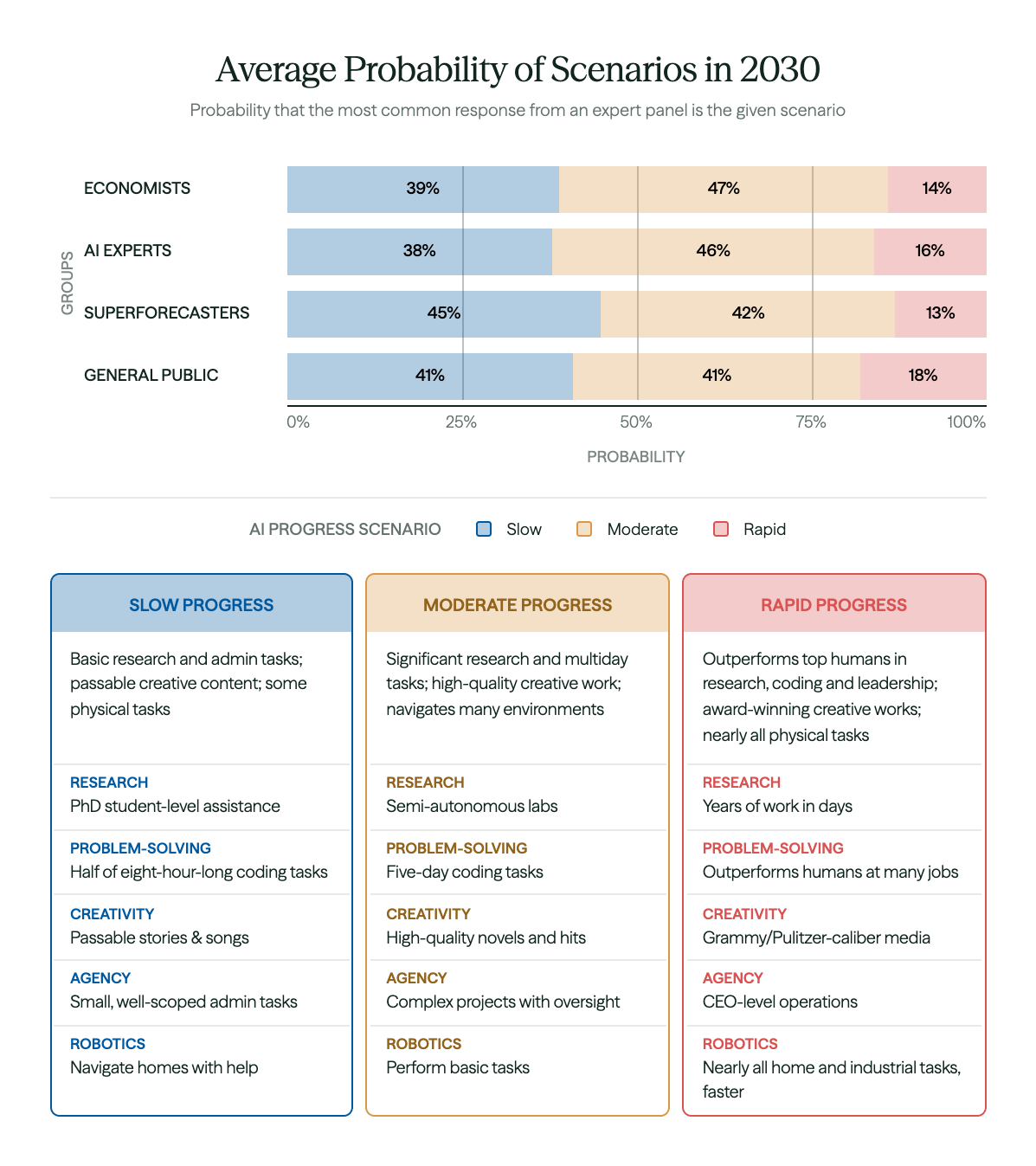
The study highlights a high-impact “rapid progress” scenario where AI systems outperform humans across many tasks, run businesses at the level of a competent CEO, and deploy robots capable of handling most in-home and industrial work.
Economists and experts assign a 14% probability that the extreme scenario will define the world by 2030, with a combined 61% probability that either moderate or rapid AI progress unfolds.
Under an extremely rapid trajectory, the economic effects by 2050 are substantial.
Annual GDP growth is projected to rise to 3.5%, compared to 2.4% in 2025, while labor force participation drops to 55%, implying roughly 10 million fewer jobs. And wealth concentration intensifies sharply, with the top 10% of households are projected to hold 80% of total wealth, the highest level since 1939.
Despite these projections, economists’ baseline forecasts remain close to current trends when not conditioned on rapid AI progress.
Median expectations point to GDP growth of 2.5% in both 2030 and 2050, with labor force participation declining more gradually to 61% in 2030 and 58% in 2050.
The research finds that while economists give AI a high chance of making substantial progress, they also believe that the economy won’t change in a big way.
“What explains economists giving a high chance of substantial AI progress, yet having an overall belief that economic outcomes won’t shift dramatically?
In their written rationales, economists cited the following reasons:
• slow and uneven diffusion of AI across sectors
• infrastructure bottlenecks (energy, chips, data centers)
• demographic and geopolitical headwinds
• long lags between the discovery of general-purpose technologies and measured productivity gains.
The median view is closer to ‘AI will take a long time to show up in macroeconomic statistics and will offset demographic headwinds’ than ‘AI won’t matter at all.'”
Disclaimer: Opinions expressed at CapitalAI Daily are not investment advice. Investors should do their own due diligence before making any decisions involving securities, cryptocurrencies, or digital assets. Your transfers and trades are at your own risk, and any losses you may incur are your responsibility. CapitalAI Daily does not recommend the buying or selling of any assets, nor is CapitalAI Daily an investment advisor. See our Editorial Standards and Terms of Use.