


The investor who became famous after nailing the 2008 housing market collapse is issuing a dire warning, saying a corner of the credit market may be approaching a familiar breaking point.
In a new post on X, Big Short investor Michael Burry responds to remarks from DoubleLine Capital CEO Jeffrey Gundlach, who compares today’s private credit environment to the early stages of the 2007 financial crisis.
According to Gundlach, private credit is now in a similar stage as mortgage-backed securities in 2007, when bad assets were about to blow up.
“In 2007, I was sitting on a large amount of undrawn commitments to invest in bombed-out MBS securities.
Didn’t invest at all until 2008, and I didn’t get fully invested until March 2009.
It’s 2007 for Private Credit.”
Burry says people in private credit (PC) and private equity (PE) have been very good at delaying the reckoning, which he believes is now imminent.
“I believe everyone in PE and PC knows exactly what is going on. PE is remarkably proficient at kicking the can down the road, but it looks like the end of the road to me.”
The private credit market is a non-bank lending system where investment firms raise capital and issue loans directly to businesses, often at higher rates than traditional bank financing. Lenders in the sector have been grabbing headlines over the past few months, as investors have rushed to withdraw their money amid fears of the industry’s heavy software exposure.
In response, private credit funds are either banning or limiting redemptions, triggering further investor concerns.
AI is rattling tech investors so far this year, as they believe that artificial intelligence will crush the valuations of software businesses. The iShares Expanded Tech-Software Sector ETF (IGV), which tracks the performance of US software giants, is down about 25% year-to-date.
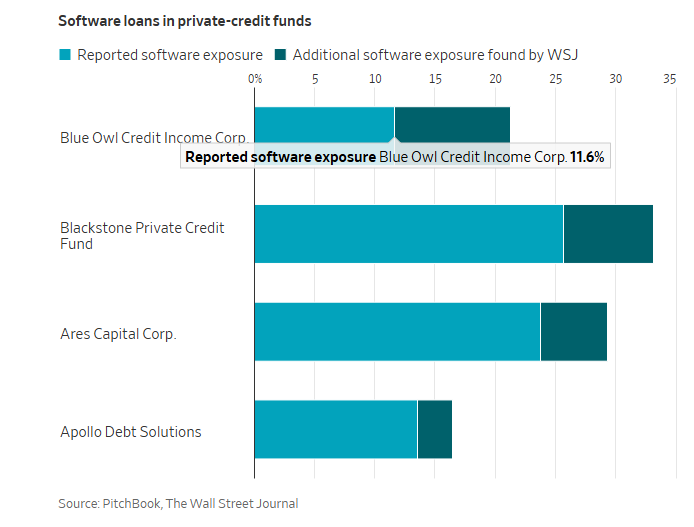
An analysis by the Wall Street Journal shows that four large private credit funds – Blue Owl, Blackstone, Apollo and Ares Capital – have an average software exposure of 25%, almost twice as much as advertised.
Disclaimer: Opinions expressed at CapitalAI Daily are not investment advice. Investors should do their own due diligence before making any decisions involving securities, cryptocurrencies, or digital assets. Your transfers and trades are at your own risk, and any losses you may incur are your responsibility. CapitalAI Daily does not recommend the buying or selling of any assets, nor is CapitalAI Daily an investment advisor. See our Editorial Standards and Terms of Use.