


A new financial industry survey shows that payment fraud remains a persistent and growing threat to US firms, but only a few are using the best tool to stop it.
In its 2026 AFP Payments Fraud and Control Survey Report, the Association for Financial Professionals finds that 76% of firms in the US experienced attempted or actual payments fraud last year.
The survey, which was underwritten by Truist Bank to poll 465 treasury practitioners representing US organizations of varying sizes and industries, also finds that about three-quarters of businesses were impacted by business email compromise (BEC) last year.
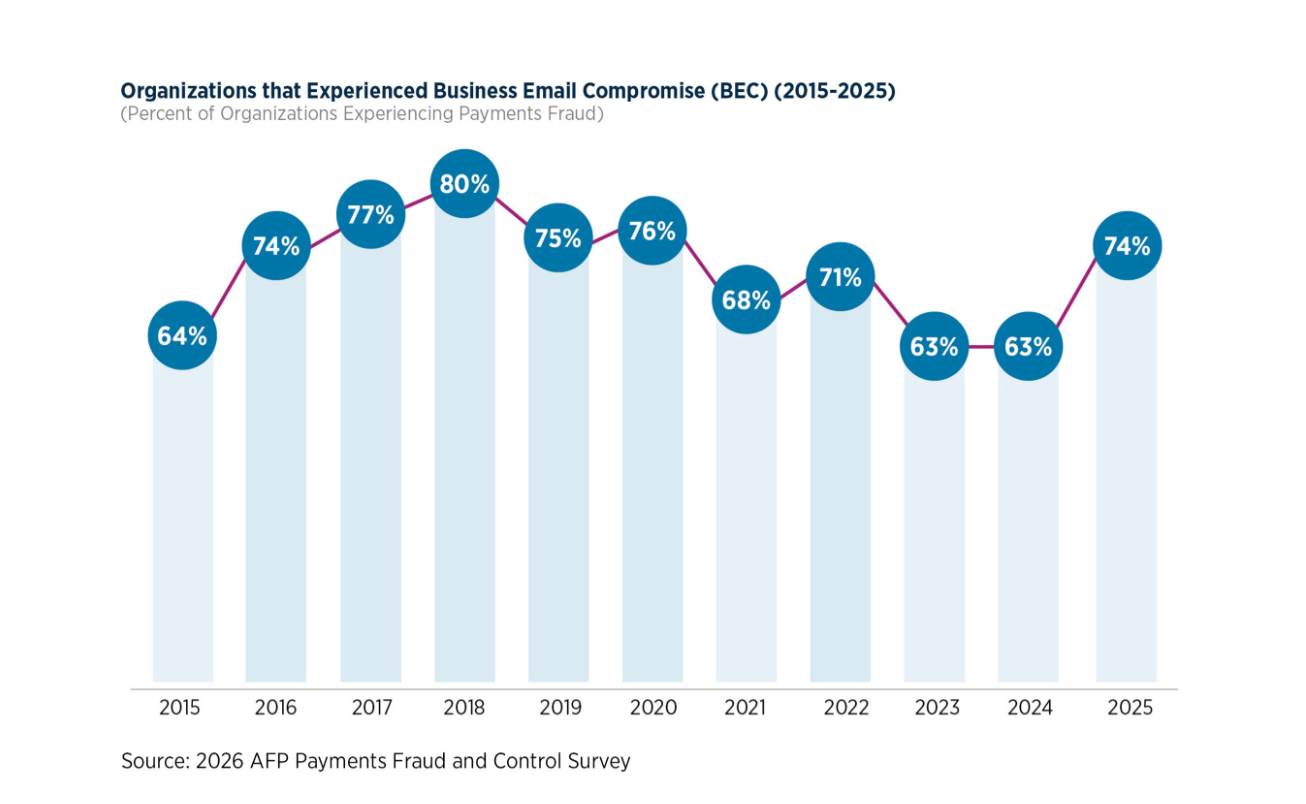
Even though the majority of firms are being targeted by fraud schemes, survey data shows that only 17% use AI to fight back, despite its effectiveness in mitigating threats.
“Organizations using AI for fraud mitigation reported enhanced efficiency in fraud reporting (49%), improved detection of deepfake technology (45%) and real-time identification capabilities (43%).”
AFP’s director of Treasury Practice, Tom Hunt, CTP, urges businesses to integrate AI tools alongside traditional defensive measures in an effort to combat fraudulent schemes.
“AFP’s survey demonstrates how the treasury function has solidified its role as a primary line of defense against fraud. Integrating AI-powered technologies with traditional controls will ensure the profession stays ahead of evolving fraud tactics as a continuous improvement.”
The AFP also warns that the lag in the adoption of AI fraud detection tools leaves many firms exposed to heavy financial losses.
“While AI technology has been shown to enhance fraud detection, many organizations are slow to adopt it due to concerns about costs, the perceived immaturity of the technology, and reliance on existing controls or partners. This delay, combined with ongoing reliance on checks and a rise in BEC attacks, leaves organizations vulnerable to significant, often unrecoverable financial losses.”
Disclaimer: Opinions expressed at CapitalAI Daily are not investment advice. Investors should do their own due diligence before making any decisions involving securities, cryptocurrencies, or digital assets. Your transfers and trades are at your own risk, and any losses you may incur are your responsibility. CapitalAI Daily does not recommend the buying or selling of any assets, nor is CapitalAI Daily an investment advisor. See our Editorial Standards and Terms of Use.