


A new report from PwC says the gap between companies that are getting real returns from artificial intelligence and those that are not has become impossible to ignore.
In a new report, PwC introduces the concept of “AI fitness,” defining it as the ability to focus AI on outcomes that matter, build the foundations that enable AI to deliver returns, while rapidly scaling what works to turn pilots into profits.
PwC highlights a striking performance gap between the most AI-fit companies and their peers.
“The most AI-fit companies are getting a 7.2 times AI-driven performance boost — a combination of AI-driven revenues and cost reductions — over their peers.”
According to PwC, AI fitness rests on two pillars. The first is six foundational capabilities: strategy, investment, workforce, data and technology, governance and innovation. The second is three measures of AI use: breadth and depth of deployment, sophistication of application and the ability to capture value from industry convergence.
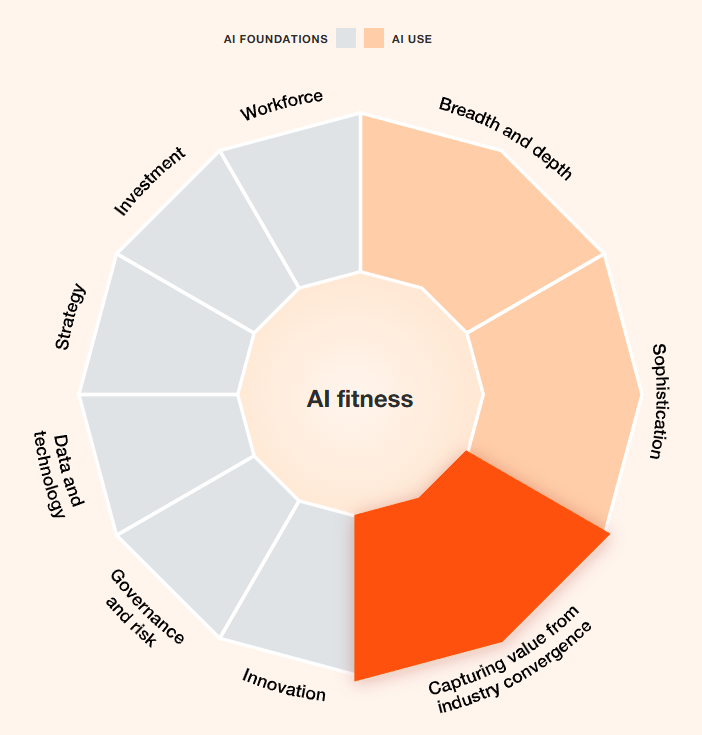
PwC notes that the last measure, industry convergence, most clearly separates the leaders from the rest. The most AI-fit companies are twice as likely as their peers to use AI to compete beyond their own sector, entering adjacent markets and revenue streams that their competitors have not yet considered.
“This factor assesses the extent to which AI enables cross-sector competition or collaboration. That could be sensing emerging value pools between sectors, responding to shifts in customer needs, or collaborating across sectors to unlock new value from ecosystem partnerships.
AI leaders are more likely to use AI to derive growth from industry convergence, the strongest AI fitness factor influencing AI-driven performance.”
The data also backs up the compounding advantage of combining strong foundations with aggressive AI use.
“Companies get 2 times the improvement in AI-driven performance when they bolster increased AI use with stronger foundations.”
PwC also finds that the most AI-fit companies are 80% more likely to systematically track the business impact of their AI initiatives, suggesting that measurement and accountability are as important as the technology itself.
Disclaimer: Opinions expressed at CapitalAI Daily are not investment advice. Investors should do their own due diligence before making any decisions involving securities, cryptocurrencies, or digital assets. Your transfers and trades are at your own risk, and any losses you may incur are your responsibility. CapitalAI Daily does not recommend the buying or selling of any assets, nor is CapitalAI Daily an investment advisor. See our Editorial Standards and Terms of Use.