


A new survey from the Federal Reserve is raising fresh concerns about who is actually benefiting from artificial intelligence in the workplace, and the data suggests the technology could deepen existing inequalities rather than closing them.
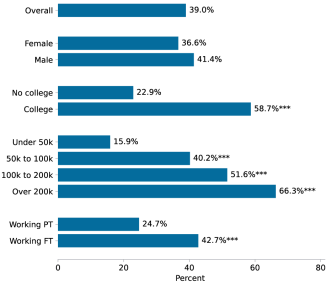
The Fed’s November 2025 Survey of Consumer Expectations finds that among currently employed respondents, 39% report using AI tools in their current job or having used them in the past twelve months.
According to the Fed, the figure masks a stark divide across income, education and employment status.
The Fed says AI adoption at work rises from 15.9% among workers earning under $50,000 annually to 66.3% among those earning over $200,000, a gap of more than four times.
Looking at educational attainment, college graduates are far more likely to use AI at work than those without a degree.
“College graduates are more than twice as likely to have used AI tools at work in the past twelve months as those without a college degree — 58.7% versus 22.9%.”
Full-time workers are also considerably more likely to use AI than part-time workers, with adoption rates of 42.7% versus 24.7%, respectively.
“These patterns suggest that AI adoption at work currently favors higher-income, higher-educated, and full-time workers. This finding raises questions about whether AI may widen rather than narrow existing labor market inequalities.”
For workers who have used AI tools, the Fed finds that the productivity benefits are real. About 66% report that AI increases their personal productivity, with 40% saying the tools help them finish tasks faster and 22% saying they are able to complete more tasks overall.
Meanwhile, 19% say they are still learning to use AI, meaning tasks are actually taking longer during the adjustment period.
The Fed also notes that barriers to adoption remain significant across the broader workforce. About 37% of employed respondents say their workplace does not offer AI tools at all, and an additional 11% say their employer actively prohibits their use.
Disclaimer: Opinions expressed at CapitalAI Daily are not investment advice. Investors should do their own due diligence before making any decisions involving securities, cryptocurrencies, or digital assets. Your transfers and trades are at your own risk, and any losses you may incur are your responsibility. CapitalAI Daily does not recommend the buying or selling of any assets, nor is CapitalAI Daily an investment advisor. See our Editorial Standards and Terms of Use.