


Jamie Dimon says today’s market backdrop is starting to resemble the mid-2000s, when easy gains masked mounting risks.
Speaking at JPMorgan’s 2026 Company Update, the bank’s chief executive said he was witnessing investor behavior reminiscent of the years leading to the 2008 Global Financial Crisis.
While Dimon says people are enjoying market gains, he warns that the music will eventually stop.
“Unfortunately, we did see this in ’05 and ’06 and ’07, almost the same thing. The rising tide was lifting all boats. Everyone was making a lot of money. I don’t know how long it’s going to be great for everybody.
I see a couple of people doing some dumb things.
They’re just doing dumb things to create in AI or say they’re winning in the markets business, something like that.”
Dimon’s warning comes as fellow banking giant UBS flags rising risks in the $1.8 trillion private credit market. In a research note reported by the Financial Times, UBS credit strategist Matthew Mish warns that severe AI disruption could trigger meaningful defaults in private credit, as well as in US high yield bonds and US leveraged loans.
“Investors increasingly want to talk about AI disruption and our tail risk scenario: a rapid, severe AI disruption. This is not our baseline; however, at the risk of Monday morning quarterbacking, over 80% of what is written below was published back in November. What is new: a clearer catalyst – rapid, severe AI disruption… Assuming contagion impacts not modelled in our earlier note, we anticipate US HY, LL and PC [high yield, leveraged loan and private credit] defaults could rise to 3-6%, 8-10% and 14-15%, respectively.”
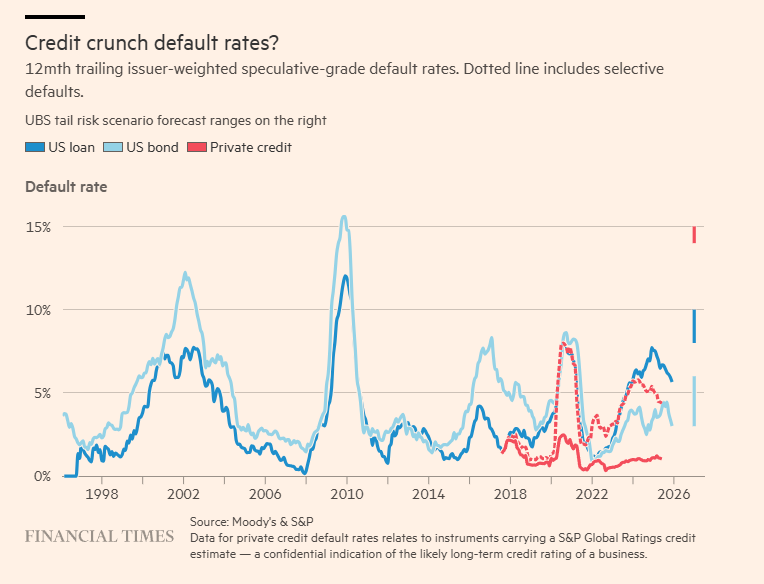
Financial Times editor Roula Khalaf says the figures match conditions witnessed during the heights of the Global Financial Crisis and the dot-com bubble.
But UBS highlights that the figures are its risk-case scenario, not its base-case projections.
Disclaimer: Opinions expressed at CapitalAI Daily are not investment advice. Investors should do their own due diligence before making any decisions involving securities, cryptocurrencies, or digital assets. Your transfers and trades are at your own risk, and any losses you may incur are your responsibility. CapitalAI Daily does not recommend the buying or selling of any assets, nor is CapitalAI Daily an investment advisor. See our Editorial Standards and Terms of Use.