


JPMorgan Chase CEO Jamie Dimon warns of a looming risk that could derail the US equity market’s ascent to new all-time highs.
The News
In a new interview at the Reagan National Economic Forum, Dimon says he’s starting to see signs of froth and mania in the stock market as companies like Micron Technology (MU) climb to a $1 trillion valuation, the fastest on record after doubling from $500 billion in just 48 trading days.
“I do think the market is exuberant. I’ve seen this before. Of course, exuberance can go on for a long time, and it’s not bad. Earnings are up 15%- 20% this year, and a lot of these companies have huge order books, so it may be justified.
But there is also hype in some of this stuff. Credit spreads are very low. So I look at all that as actually a risk. If something goes wrong, those asset prices can come down. Interest rates are gravity to asset prices.”
Looking closer at interest rates, Dimon points to the bond market, where the 10-year yield has recently breached the historically crucial level of 4.5%. Dimon warns that a long list of inflationary factors could push bond interest rates higher later this year.
“But the re-militarization of the world is kind of inflationary. AI spending in the short run is inflationary. Restructuring of trade fundamentally has an inflationary component. Restriction of immigration has an inflationary component, $2 trillion of [government] spending [is inflationary]…
So I look at this long list of stuff, and obviously oil prices and food prices, so I hope it doesn’t go up much, but talking about interest rates, the 10-year bond is set by the market. It’s at 4.5%. That may be the right equilibrium rate today based on what people know. But remember, equilibrium prices and what happens are two different things. And if you had inflation at 2%, the short rate should be 3.5%… I think [inflation] could easily hit 4% later this year.”
What It Means for Investors
Jamie Dimon joins Morgan Stanley CIO Mike Wilson in sounding the alarm about rising bond yields. Dimon clearly says that “interest rates” act like gravity to asset prices because higher bond yields have historically triggered stock market corrections.
Between 2022 and 2023, the S&P 500 plummeted more than 25%, while the US 10-year yield rose from 1.33% to 5.02% over the same period. In 2025, the S&P 500 dropped around 20% while the 10-year yield climbed from 3.6% to 4.8% from late 2024 to early 2025.
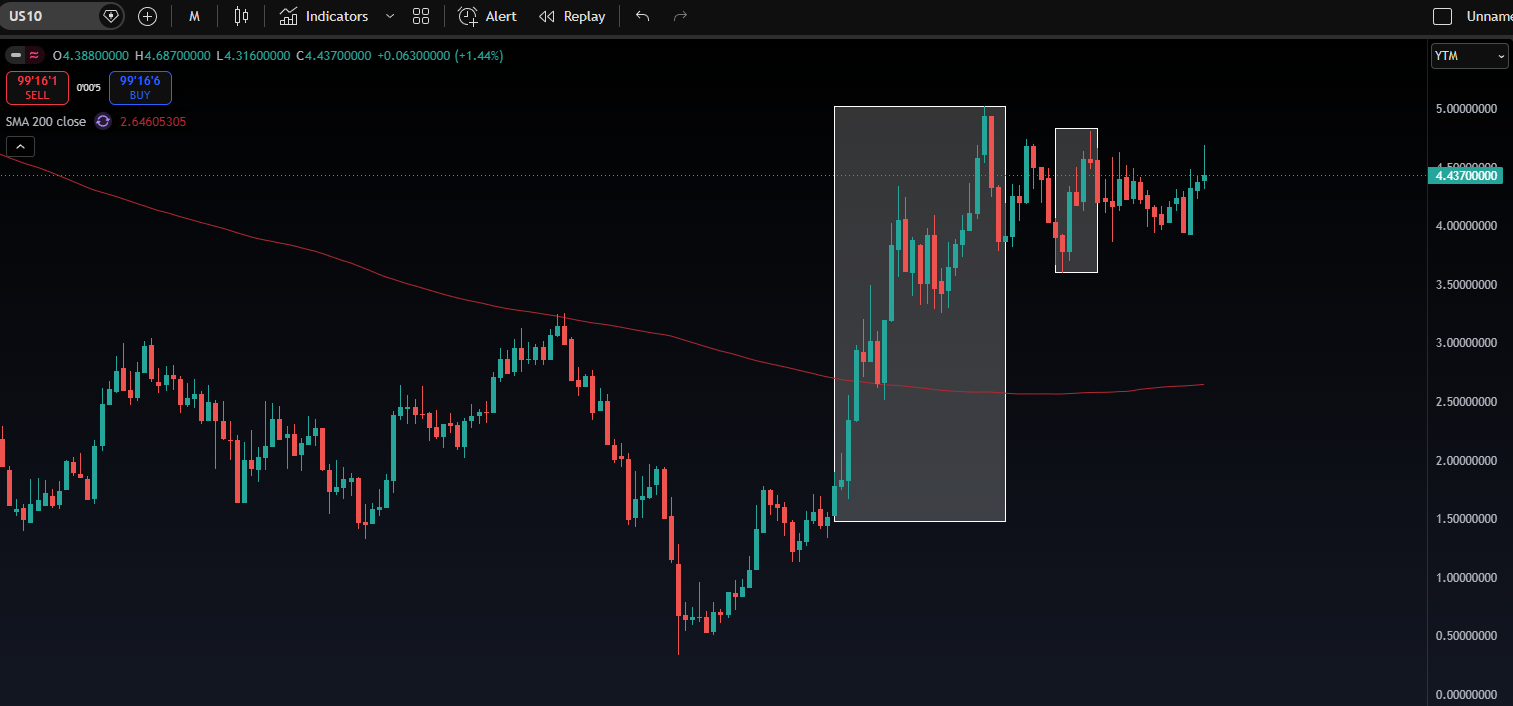
Legendary investor Steve Eisman said he sold off some stocks after the 10-year Treasury bond yield shattered 4.5%, noting that the level is a danger zone that previously triggered a stock market correction over the last four years.
Now, Dimon appears to imply that interest rates or bond yields could move higher as he expects inflation to reach 4% later this year. Investors have often demanded higher interest rates on Treasuries when inflation is on the up and up because they want to be paid enough to offset the loss of purchasing power. If Dimon expects inflation to hit 4% in the coming months, bond yields will likely be significantly higher than 4.5%.
The rising interest rates could drag equity prices lower as investors sell stocks and rotate into bonds that offer attractive yields and less uncertainty.
If Dimon is right, a stock market correction could be an opportunity for long-term investors to accumulate high-performing semiconductor and tech stocks at a discount in anticipation of the next phase of the equity bull market.
Disclaimer: Opinions expressed at CapitalAI Daily are not investment advice. Investors should do their own due diligence before making any decisions involving securities, cryptocurrencies, or digital assets. Your transfers and trades are at your own risk, and any losses you may incur are your responsibility. CapitalAI Daily does not recommend the buying or selling of any assets, nor is CapitalAI Daily an investment advisor. See our Editorial Standards and Terms of Use.