


A sweeping new study from OpenAI maps the impact of AI across hundreds of occupations and finds that while nearly one in five jobs faces a higher short-term automation risk, the picture is more nuanced and less uniformly dire than most AI jobs narratives suggest.
The research introduces the AI Jobs Transition Framework, which looks beyond simple exposure by combining three factors: how technically exposed a job is, how necessary humans remain, and how demand might change as costs fall.
The study covers more than 900 occupations representing 99.7% of U.S. employment. According to OpenAI, only a slice of the workforce faces immediate pressure.
“18% of jobs are at a relatively higher short-term automation risk.”
The firm also says that about a quarter of jobs are likely to shift rather than disappear, while highlighting that AI could expand some roles.
“24% of jobs may see declining employment as task composition shifts while workers remain necessary for key tasks. 12% of jobs could grow because of AI as lower effective cost may increase utilization, affordability, access, or quality-adjusted output.”
At the same time, OpenAI says nearly half of jobs are expected to see a limited short-term impact.
“46% of jobs are likely to see less change in the short term.”
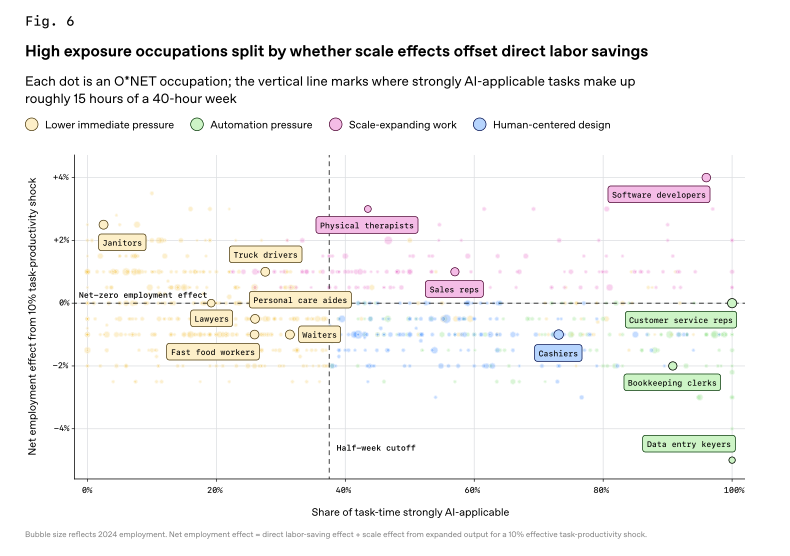
Looking at specific jobs, the AI giant finds that the most exposed roles are those where AI-applicable tasks make up the largest share of a worker’s time.
Data entry keyers, bookkeeping clerks and customer service representatives sit at the highest-risk end of the spectrum, with AI-applicable tasks accounting for close to 100% of their working hours and negative projected net employment effects.
At the other end of the spectrum, software developers stand out as the clearest beneficiary, combining near-total AI applicability with strong scale effects that are expected to expand rather than contract employment. Physical therapists and sales representatives also show positive net employment effects, reflecting the human necessity component of their roles that AI cannot easily replicate.
OpenAI cautions that the findings are short-term projections rather than permanent verdicts, noting that many occupation characteristics and the borders between occupations themselves are malleable over time, and that further technological advancements may change the nature of human necessity in ways that are difficult to predict today.
Disclaimer: Opinions expressed at CapitalAI Daily are not investment advice. Investors should do their own due diligence before making any decisions involving securities, cryptocurrencies, or digital assets. Your transfers and trades are at your own risk, and any losses you may incur are your responsibility. CapitalAI Daily does not recommend the buying or selling of any assets, nor is CapitalAI Daily an investment advisor. See our Editorial Standards and Terms of Use.