


The Organisation for Economic Co-operation and Development (OECD) says borrowing costs are soaring as hyperscalers compete with governments to get funds from the debt markets.
In its Global Debt Report 2026, OECD says governments and companies across the globe are projected to borrow a record $29 trillion from bond markets this year, about 17% higher than the figure recorded in 2024.
Looking specifically at hyperscalers, the OECD says the nine major AI players are projected to borrow $1.2 trillion from bond markets to finance their AI ambitions from 2026 to 2030. According to the international organization, hyperscalers’ appetite for debt could reshape the bond market, increase systemic financial risk and blur the lines between equity and debt investing.
“The technology sector represents an increasing share of the global bond market, a trend that is set to continue given the magnitude of the hyperscalers’ financing needs. This might bring bond market sector, and even single-firm, concentration closer to that observed in equity markets in recent years. Given the uncertainty about the useful life of data centres, a key AI infrastructure, and the nature of their value as collateral, there seems to be a convergence even in the type of risks financed by equity and debt markets.”
And it’s not just the hyperscalers borrowing money to fund the AI boom. According to the OECD, the real estate, energy and hardware development industries are expected to put pressure on debt markets.
“This calls into question the ability of the currently USD 17.2 trillion global non-financial corporate bond market to absorb new supply of this magnitude, especially in a context of still-expanding sovereign bond borrowing and a changing investor base.”
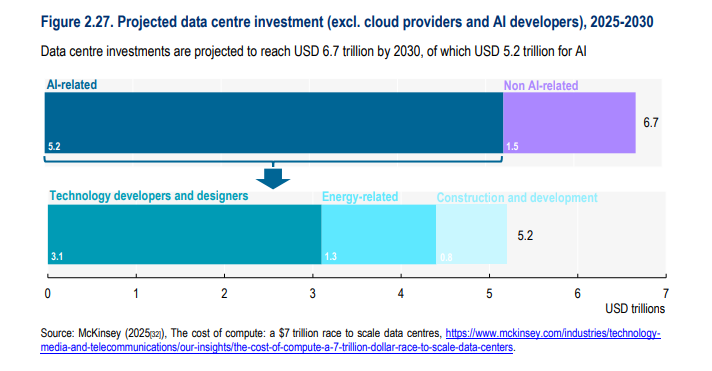
While the debt markets have been resilient so far, the OECD warns that hyperscaler borrowing and other structural issues are emerging under the surface that could rattle the bond market.
“This stability, however, masks deeper structural developments. The cost of long-term borrowing has risen, and the resulting shift in issuance towards shorter maturities increases refinancing risks. The growing role of more price-sensitive investors may also make debt markets more vulnerable to shocks. Their future resilience is therefore not guaranteed. This is particularly important as the scaling of AI and growing defense spending are expected to further increase borrowing from the markets.”
Disclaimer: Opinions expressed at CapitalAI Daily are not investment advice. Investors should do their own due diligence before making any decisions involving securities, cryptocurrencies, or digital assets. Your transfers and trades are at your own risk, and any losses you may incur are your responsibility. CapitalAI Daily does not recommend the buying or selling of any assets, nor is CapitalAI Daily an investment advisor. See our Editorial Standards and Terms of Use.