


Recent US college graduates are facing a structurally tougher job market, as artificial intelligence and a sharp pullback in tech hiring are squeezing entry-level opportunities.
In a research briefing, Oxford Economics finds that rising unemployment among recent college graduates is not a cyclical blip, but the result of a deeper shift in how companies hire, particularly in technology and professional services.
The report focuses on workers aged 22 to 27 with at least a bachelor’s degree and shows that this group has played an outsized role in the rise in unemployment since mid-2023. Although recent graduates account for only about 5% of the total labor force, they contributed roughly 12% of the increase in the national unemployment rate over that period.
Oxford Economics identifies the core problem as a collapse in entry-level hiring, especially in tech-adjacent roles that have been early targets for automation.
Since mid-2023, the unemployment rate for recent college graduates has risen about 1.6 percentage points, nearly three times the increase seen in the overall unemployment rate during the same period.
The data shows that roughly 85% of that rise comes from new labor market entrants who cannot find work, rather than from mass layoffs, signaling a blockage at the entry point rather than broad-based job losses.
The pressure is most acute in professional and business services, where job openings have dropped more than 40% since 2021. Oxford Economics notes that computer science and mathematical occupations are disproportionately exposed to automation, and that AI adoption appears to be displacing entry-level roles normally filled by recent graduates.
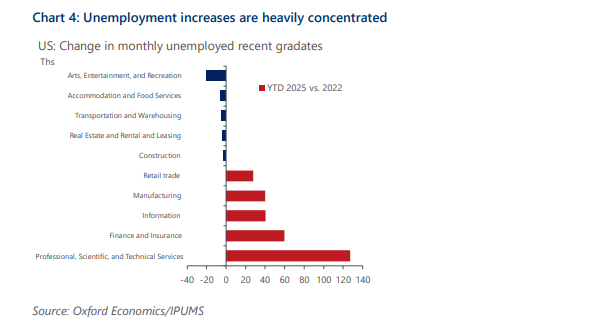
While employment for older workers in these fields has continued to grow modestly, employment for recent graduates aged 22 to 27 has declined by about 8% since 2022, underscoring the generational divide.
“We concluded that a high adoption rate by information companies, along with the sheer employment declines in these roles since 2022, suggested some displacement effect from AI. Digging deeper, the largest displacement seems to be in entry-level jobs normally filled by recent graduates.”
Importantly, the report finds little evidence that graduates are pivoting away from their chosen fields. Underemployment rates remain broadly stable, and most unemployed graduates continue searching for college-level roles rather than accepting jobs that do not require a degree.
Oxford Economics warns that this mismatch between labor supply and demand is likely to keep recent graduate unemployment elevated in the near term, absent a sharp rebound in tech hiring or a large exit from the labor force, both of which appear unlikely.
Last year, Anthropic CEO Dario Amodei warned that AI would wipe out 50% of all entry-level white-collar jobs and push unemployment to 10-20% in the next one to five years.
But AI Czar David Sacks disputed the AI job displacement narrative, citing data showing that employment growth has been faster in jobs with high AI exposure than in the broader workforce.
Disclaimer: Opinions expressed at CapitalAI Daily are not investment advice. Investors should do their own due diligence before making any decisions involving securities, cryptocurrencies, or digital assets. Your transfers and trades are at your own risk, and any losses you may incur are your responsibility. CapitalAI Daily does not recommend the buying or selling of any assets, nor is CapitalAI Daily an investment advisor. See our Editorial Standards and Terms of Use.