


The US economy is slowing in visible places, but JPMorgan says a new growth engine is now doing a lot of the heavy lifting.
In a new Wealth Management report, global investment strategists Federico Cuevas and Justin Biemann say the unemployment rate has climbed to 4.4% from just 3.5% in January.
But the analysts note that the bank is seeing a new wave of job openings and hiring plans that suggest the labor market softness may be bottoming out instead of continuing to worsen. For now, the bank believes the labor market is bent, but not broken.
As the US job market begins to flash signs of recovery, the analysts note that a new growth driver has emerged, one that could support America’s consumer-driven economy. The bank’s strategists say the US economy will continue to chug along even if the consumer slows due to hundreds of billions of dollars in AI capital expenditure (CapEx) slated for next year.
“The US is still a consumer-driven economy – household spending is roughly two-thirds of GDP, and that hasn’t changed. What has changed is where a lot of the growth is coming from at the margin. In this phase of the cycle, the investment side of the economy is doing an unusually large share of the work…
Our investment bank estimates that capex related to artificial intelligence (AI) will total around $500 billion this year and rise to roughly $700 billion next year, as firms keep building out data centers, chip capacity, power infrastructure and networks. Looking further out, we estimate funding needs in 2030 will be in excess of $1.4 trillion a year. These are multi-year commitments.”
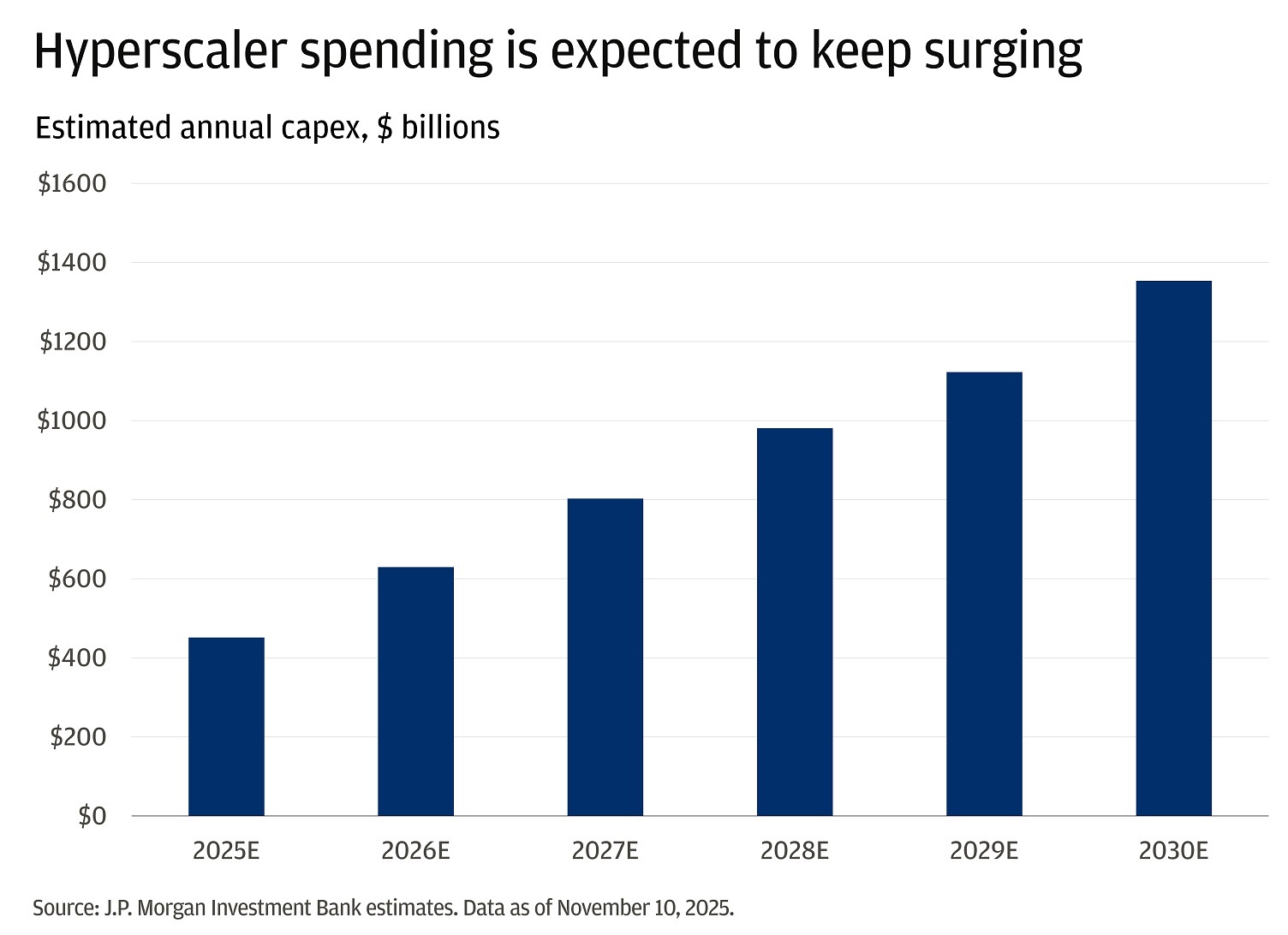
JPMorgan concludes that it expects a stronger US economy next year amid a resilient job market, financial policies shifting to neutral and a powerful AI CapEx wave.
“In fact, reflecting our confidence in the strength of the economy, we’re only expecting one more rate cut next year – while investors are pricing in more than two. Given this backdrop, we prefer risk assets like stocks to bonds and believe investors should consider real assets like infrastructure to help mitigate the impact of inflation.”
Disclaimer: Opinions expressed at CapitalAI Daily are not investment advice. Investors should do their own due diligence before making any decisions involving securities, cryptocurrencies, or digital assets. Your transfers and trades are at your own risk, and any losses you may incur are your responsibility. CapitalAI Daily does not recommend the buying or selling of any assets, nor is CapitalAI Daily an investment advisor. See our Editorial Standards and Terms of Use.