


A Boston-based private research university is looking more closely at the impact of AI on the labor market to find out which jobs are most vulnerable.
In its American AI Jobs Risk Index, Tufts University says that in the next two to five years, AI could disrupt between 2.7 and 19.5 million jobs across all categories, industries, cities and states, depending on the rate of adoption.
According to the university, the total income loss from AI job disruption could hover between $200 billion and $1.5 trillion, accounting for 2% to 15% of total wage and salary income across the US.
“While AI exposure captures how much a job can be affected by emerging technologies, AI job vulnerability goes a step further. It measures how likely that exposure will result in actual job loss or significant restructuring. Vulnerability reflects the translation of technical potential into economic impact, considering both what AI can do and how industries, firms, and workers respond to its adoption.”
Tufts University’s data shows that writers and authors are the most vulnerable to AI job loss, with 57% of roles in the field at risk of displacement or restructuring. Computer programmers and web designers are tied at 55%, followed by editors at 54% and mathematical science occupations at 48%.
Next up are web developers and database architects, as 46% of roles in the fields are at risk of displacement, followed by operations research analysts at 45% and atmospheric and space scientists at 44%.
Sociologists are next at 43%, followed by technical writers and statisticians at 42% and political scientists at 40%.
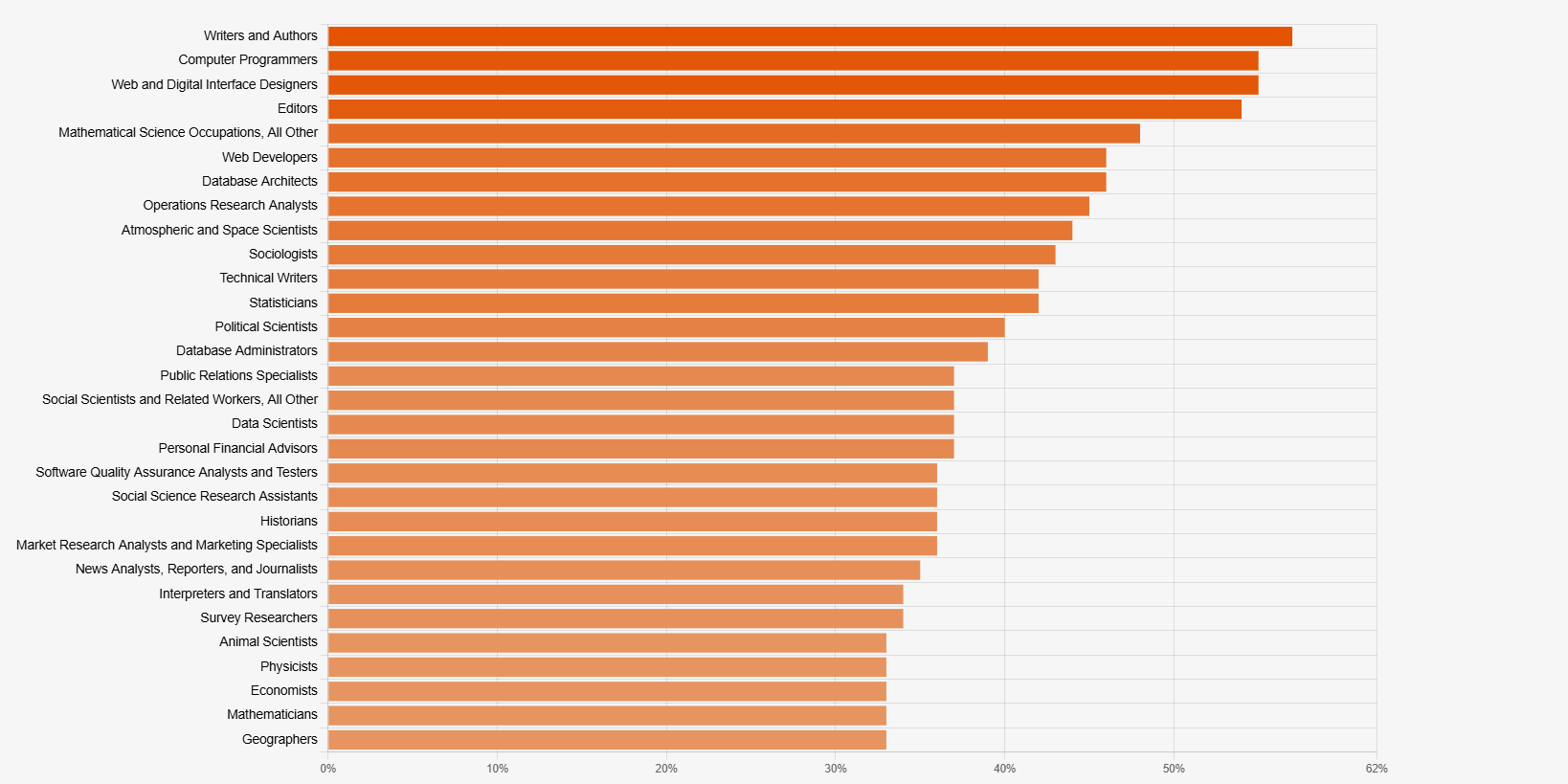
You can check the estimated percentage of job loss in your occupation here.
Disclaimer: Opinions expressed at CapitalAI Daily are not investment advice. Investors should do their own due diligence before making any decisions involving securities, cryptocurrencies, or digital assets. Your transfers and trades are at your own risk, and any losses you may incur are your responsibility. CapitalAI Daily does not recommend the buying or selling of any assets, nor is CapitalAI Daily an investment advisor. See our Editorial Standards and Terms of Use.