


Artificial intelligence tools used in schools are increasingly spilling into students’ personal lives, introducing new emotional and social risks.
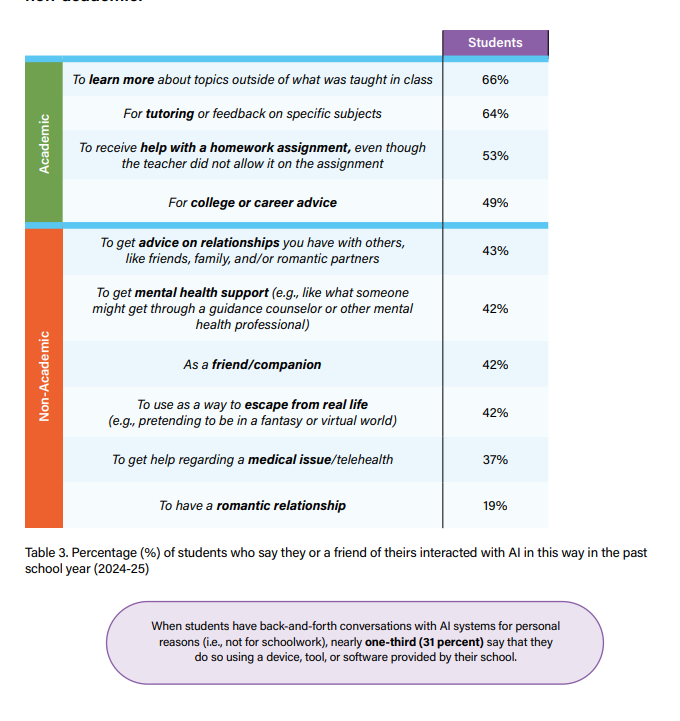
A study from the Center for Democracy and Technology finds that nearly one in five middle and high school students report using AI systems to form romantic relationships, highlighting a growing pattern of non-academic reliance on chatbots among teens.
The findings are based on nationally representative online surveys conducted between June and August 2025, covering 1,030 students in grades 9–12, 806 teachers in grades 6–12, and 1,018 parents of students in grades 6–12. Researchers examined how classroom exposure to AI tools correlates with broader, and sometimes riskier, uses outside of schoolwork.
While academic uses remain dominant, the study shows that students are engaging AI systems across a wide range of personal contexts. About 66% of students said they or a friend used AI to learn topics not taught in class, while 64% reported using it for tutoring or feedback. More concerning, however, are the non-academic uses that now rival school-related activity.
Roughly 43% of students said AI was used for advice on relationships with friends, family or romantic partners. About 42% reported using AI for mental health support, as a companion or friend or as a way to escape real life through fantasy or virtual interaction. Meanwhile, 19% explicitly said they or a peer had used AI to form a romantic relationship.
The study also finds that these interactions are not limited to personal devices. When students engage in back-and-forth conversations with AI for non-school reasons, nearly one-third said they do so using school-provided devices, software or applications, blurring the line between educational tools and unsupervised emotional engagement.
As AI chatbots grow more conversational and emotionally responsive, the study suggests that schools are becoming a critical frontline in shaping how young users relate to these systems, not just as tools, but as perceived social actors.
Disclaimer: Opinions expressed at CapitalAI Daily are not investment advice. Investors should do their own due diligence before making any decisions involving securities, cryptocurrencies, or digital assets. Your transfers and trades are at your own risk, and any losses you may incur are your responsibility. CapitalAI Daily does not recommend the buying or selling of any assets, nor is CapitalAI Daily an investment advisor. See our Editorial Standards and Terms of Use.