


A New York-based financial research firm is laying out a scenario where AI increasingly becomes one of the biggest drivers of US economic activity, triggering a collapse in the labor market.
In a new post, Citrini Research presents a scenario, not a prediction, detailing the fallout from what it calls a “Global Intelligence Crisis.”
In a memo supposedly published in June 2028, Citrini sees the unemployment rate hovering at 10.2% as AI exceeds expectations.
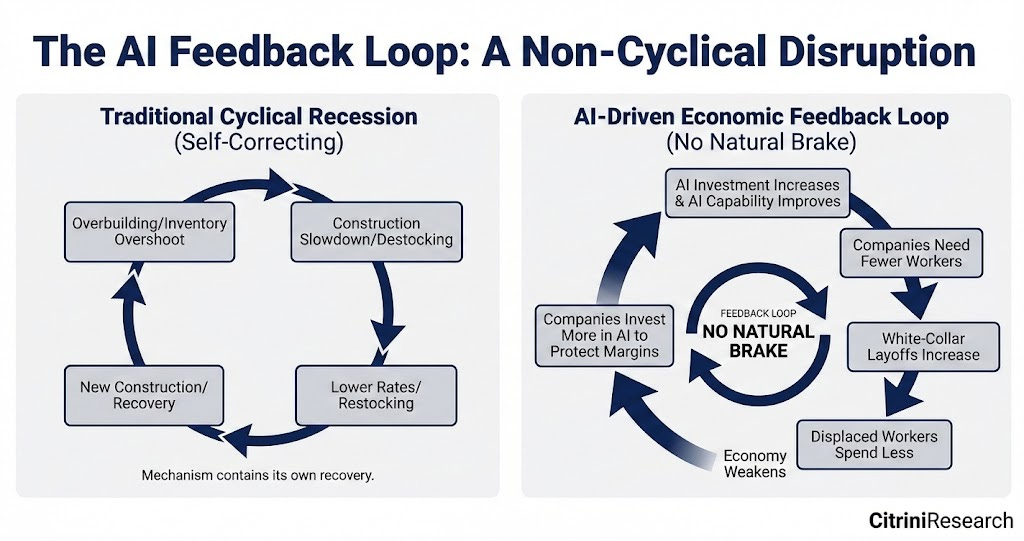
“AI capabilities improved, companies needed fewer workers, white-collar layoffs increased, displaced workers spent less, margin pressure pushed firms to invest more in AI, AI capabilities improved…”
The 2028 memo revisits 2026, when AI was crushing software and consulting names, and the labor market was softening, though not yet in a freefall. The popular consensus at the time was that tech revolutions tend to create more jobs than they destroy.
But in an AI-dominated world in 2028, Citrini sees a hollowed-out white-collar America.
“The US economy is a white-collar services economy. White-collar workers represented 50% of employment and drove roughly 75% of discretionary consumer spending. The businesses and jobs that AI was chewing up were not tangential to the US economy; they were the US economy…
AI is now a general intelligence that improves at the very tasks humans would redeploy to. Displaced coders cannot simply move to ‘AI management’ because AI is already capable of that…
White-collar openings were collapsing while blue-collar openings remained relatively stable (construction, healthcare, trades). The churn was in the jobs that write memos (we are, somehow, still in business), approve budgets, and keep the middle layers of the economy lubricated. Real wage growth in both cohorts, however, had been negative for the majority of the year and kept declining.”
In its 2028 scenario, Citrini says AI has created a feedback loop with no natural break. The firm says hyperscaler CapEx was replaced by operational expenditures (OpEx), where companies spending $100 million on employees and $5 million on AI are now spending $70 million on employees and $20 million on AI.
“AI got better and cheaper. Companies laid off workers, then used the savings to buy more AI capability, which let them lay off more workers. Displaced workers spent less. Companies that sell things to consumers sold fewer of them, weakened, and invested more in AI to protect margins. AI got better and cheaper.”
In the 2028 memo, Citrini says people are no longer talking about the AI bubble, as concerns have now shifted to America’s credit-consumer economy, where consumers are increasingly replaced by machines.
Disclaimer: Opinions expressed at CapitalAI Daily are not investment advice. Investors should do their own due diligence before making any decisions involving securities, cryptocurrencies, or digital assets. Your transfers and trades are at your own risk, and any losses you may incur are your responsibility. CapitalAI Daily does not recommend the buying or selling of any assets, nor is CapitalAI Daily an investment advisor. See our Editorial Standards and Terms of Use.