


A new study published in the Harvard Business Review suggests heavy use of AI tools is pushing some employees to their mental limits.
Researchers say the phenomenon “AI brain fry” is a form of mental fatigue caused by prolonged interaction with AI systems beyond a person’s cognitive capacity.
Participants in the study describe symptoms including mental fog, difficulty focusing, slower decision-making and headaches after extended back-and-forth work with AI tools.
The researchers define AI brain fry as mental exhaustion triggered by constant oversight of AI systems, often when workers must repeatedly review, correct and guide AI-generated outputs.
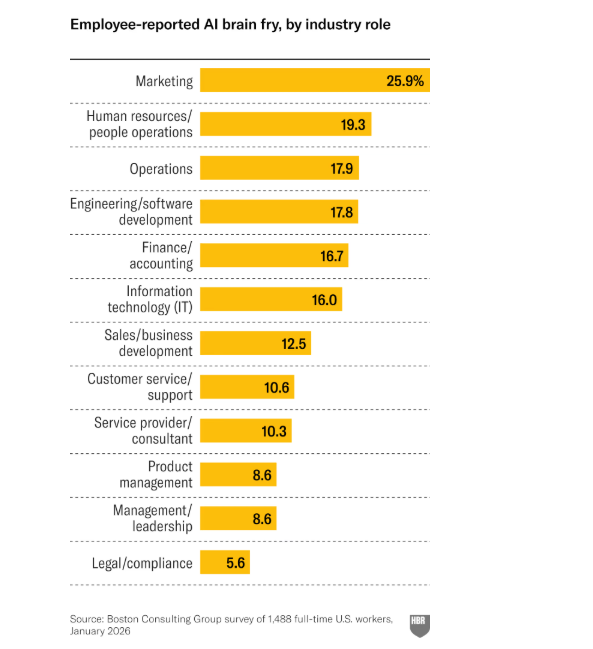
In the study, about 14% of employees who use AI for work say they have experienced this type of mental strain. But the prevalence varies widely across professions.
Among the roles studied, marketing workers reported the highest rate of AI brain fry at 26%. It is followed by HR roles at 23%, operations at 21%, engineering at 20%, finance at 19% and IT at 18%.
Legal professionals reported the lowest prevalence in the study, with only 6% saying they had experienced AI brain fry.
Researchers say the symptoms often emerge after long stretches of interacting with AI systems.
Many participants described a “buzzing” or “fog” sensation after intensive AI use, sometimes requiring them to step away from their computer to mentally reset.
The study warns that while AI tools can improve productivity, poorly designed workflows may increase cognitive strain and lead to more errors, decision fatigue and burnout among employees.
Disclaimer: Opinions expressed at CapitalAI Daily are not investment advice. Investors should do their own due diligence before making any decisions involving securities, cryptocurrencies, or digital assets. Your transfers and trades are at your own risk, and any losses you may incur are your responsibility. CapitalAI Daily does not recommend the buying or selling of any assets, nor is CapitalAI Daily an investment advisor. See our Editorial Standards and Terms of Use.