


Controversial short-seller Michael Burry says Nvidia (NVDA) is taking one big risk that’s not showing up in the headlines.
In his new post on Substack dubbed Short Thought: Nvidia Ratchets Up the Risk, Burry says the chipmaker’s February 2026 Form 10-K shows that it has accumulated purchase obligations to the tune of $95.2 billion, up from just $16.1 billion in 2025.
When inventory is added, Burry says Nvidia has $117 billion in total supply obligations, which he highlights nearly matches the firm’s operating cash flow for the year.
“To be clear, NVDA has been forced to place non-cancellable purchase orders well before demand is known. This appears structural to the new trajectory of product development and not temporary… This is not business as usual. This is risk.”
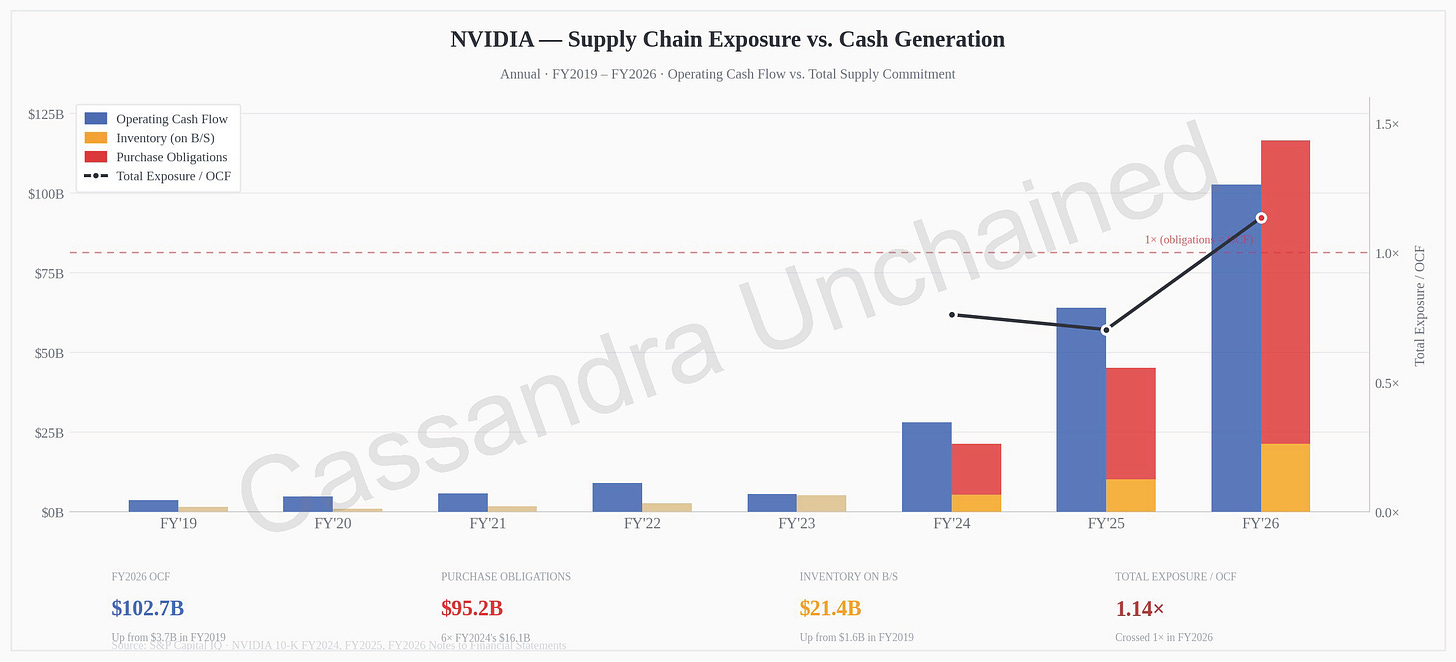
Burry says Nvidia’s deliberate decision to lock up supply chain capacity mirrors a move made by the internet infrastructure firm Cisco (CSCO) 26 years ago, before the stock cratered.
“Back in 2000-2001, Cisco extended purchase commitments with its suppliers to ensure capacity for that 50% annual growth Cisco expected. When enterprises’ IT spending and data network spending collapsed almost overnight, Cisco wrote down ~40% of its supply chain obligations and inventory, and the stock crashed severely.”
In March 2000, CSCO was trading at $82, but by October 2002, it was worth $8 – a 90% devaluation.
According to Burry, a downturn presents the greatest risk for Nvidia, noting that NVDA is in a risky position just as the market flashes signs of weakness.
“Rather than a business that would normally roll comfortably through the hills and valleys of its industry, the weighty supply obligation relative to earnings and cash flow makes a valley more of a potential entity risk for Nvidia. Any downturn, when it comes, will be more severe, perhaps even catastrophic, for Nvidia’s earnings and balance sheet.”
In November, the short-seller revealed that he holds a $186.58 million bearish bet on NVDA.
Despite Burry’s concern, Nvidia just reported record annual revenue of $215.9 billion and guided to $78 billion in Q1 revenue.
Disclaimer: Opinions expressed at CapitalAI Daily are not investment advice. Investors should do their own due diligence before making any decisions involving securities, cryptocurrencies, or digital assets. Your transfers and trades are at your own risk, and any losses you may incur are your responsibility. CapitalAI Daily does not recommend the buying or selling of any assets, nor is CapitalAI Daily an investment advisor. See our Editorial Standards and Terms of Use.