


A popular macro strategist warns that AI could disrupt the debt-based US economy far deeper than many expect.
In a new interview with Peter McCormack, macro guru Luke Gromen warns that AI productivity gains could trigger deflation, which he notes is fundamentally incompatible with America’s highly leveraged financial system.
Gromen says if the value of everything goes down, including labor, Americans would not be able to pay off their debt, triggering severe stress in the system.
“AI is going to be productivity and it’s not going to take all the jobs, and it’s just going to drive deflation way down. And in a debt-based system, that is a mathematical bookkeeping guarantee to blow up the entire freaking system.”
According to Gromen, assets like gold, stocks and crypto have been flashing signs of increased volatility as of late, suggesting that investors have no clue what lies ahead.
“I think that’s what this volatility we’re seeing is exactly what that is. When you get volatility like this in stocks and in crypto and in gold, these are very major tectonic plates pushing on each other, trying to figure out what this means. Something very big just happened. We don’t know how to position for it.”
While the macro guru believes that AI would not trigger massive job displacement, it would cause unemployment to rise and create a credit problem, pressuring the consumer credit and banking system.
“I don’t think people comprehend how disruptive it’s going to be because… the debate is still, ‘Oh, it’s gonna take all the jobs, or it’s a bubble, nothing’s gonna happen.’
No, no, no, no.
You need to understand your context. In a highly leveraged system, it’ll take some jobs, and that will be more than enough… They ain’t ever going back to work on a lot of these things.”
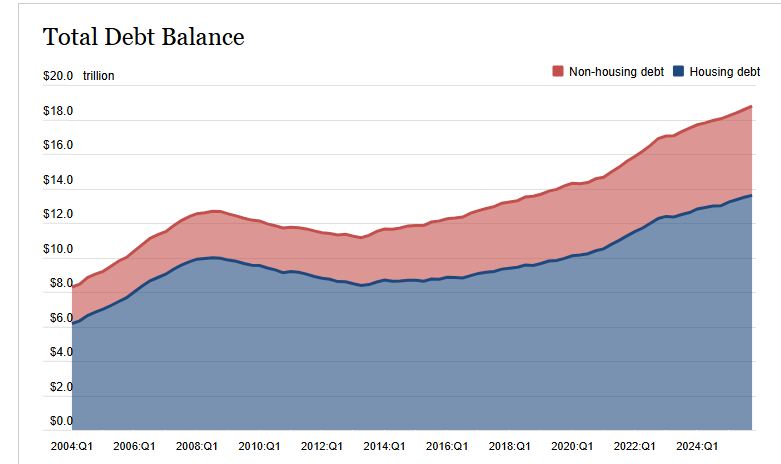
Data from the Federal Reserve shows that in Q4 2025, US household debt jumped $191 billion to hit $18.8 trillion. Mortgage balances take the lion’s share of the pie at $13.17 trillion, followed by auto loan balances at $1.67 trillion, student loan balances at $1.66 trillion and credit card balances at $1.28 trillion.
Disclaimer: Opinions expressed at CapitalAI Daily are not investment advice. Investors should do their own due diligence before making any decisions involving securities, cryptocurrencies, or digital assets. Your transfers and trades are at your own risk, and any losses you may incur are your responsibility. CapitalAI Daily does not recommend the buying or selling of any assets, nor is CapitalAI Daily an investment advisor. See our Editorial Standards and Terms of Use.