


ARK Invest founder Cathie Wood says the accelerating AI buildout is colliding with physical limits on Earth, pushing the next phase of compute growth into space.
Speaking in a Moonshots interview with Peter Diamandis, Wood says reusable rockets are a critical enabler of future AI infrastructure, noting that cost declines driven by scale could unlock entirely new demand curves.
She anchors her view in Wright’s Law, which links falling costs directly to cumulative unit growth rather than time alone.
“Well, first of all, the cost decline, again, another use case driving unit growth, and Wright’s Law is centered on unit growth. For every cumulative doubling in the number of units produced with a new technology, in this case, reusable rockets, costs decline at a consistent percentage rate. And in the case of rockets… It’s a pretty big number in terms of cost declines, but not as big, believe it or not, as industrial [robots]. In the industrial robot space, for every cumulative doubling in the number of industrial robots produced, costs declined by 50%. It’s not as high as that, but it’s well into the 20s.”
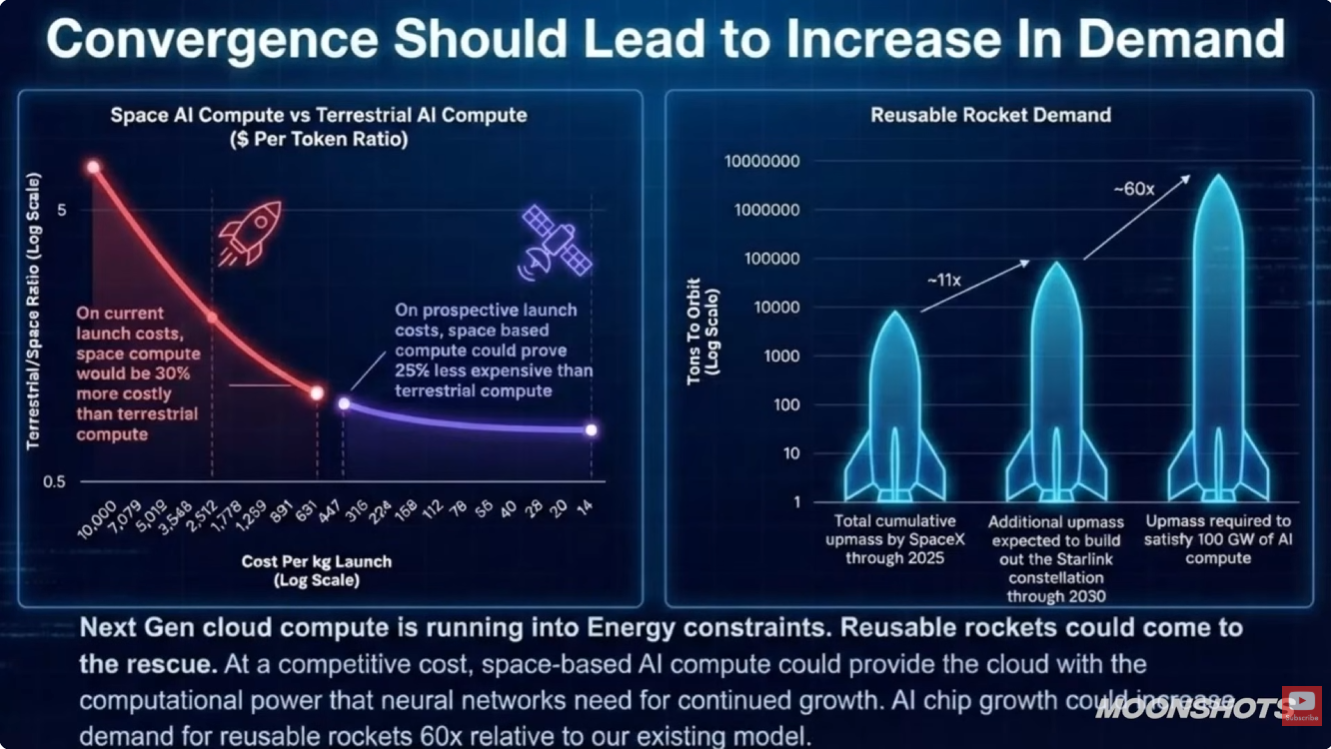
The right side of Wood’s chart indicates that, at current launch costs, space AI is 30% more expensive than ground-based compute. But with the emergence of reusable rockets, launch costs for space AI could be 25% cheaper than terrestrial compute.
According to Wood, the 25% figure might be a conservative estimate, setting the stage for the AI race to turn into a space race.
“Moore’s Law was all about time. And it is no longer working in the semiconductor industry. Wright’s Law is working in the semiconductor industry. And so what can get in the way of unit growth is the question. I don’t think regulations are going to get in the way. I think we’re into a space race here. So I think you’re right. I think we could be conservative.”
Just last week, Elon Musk said SpaceX is targeting full reusable rockets this year. Musk highlighted that reusable rockets could cut space access costs to under $100 per pound, which makes projects that send solar-powered AI satellites into space “very cheap.”
Disclaimer: Opinions expressed at CapitalAI Daily are not investment advice. Investors should do their own due diligence before making any decisions involving securities, cryptocurrencies, or digital assets. Your transfers and trades are at your own risk, and any losses you may incur are your responsibility. CapitalAI Daily does not recommend the buying or selling of any assets, nor is CapitalAI Daily an investment advisor. See our Editorial Standards and Terms of Use.