


A new Anthropic study is directly challenging the popular narrative that AI is taking over white-collar jobs as the technology automates routine tasks.
In its latest Anthropic Economic Index report, the Claude creator analyzed real-world usage of Claude across millions of conversations from November 2025 to understand how AI is actually being deployed inside human work.
The study applied Anthropic’s task-level “primitives” to measure not just whether AI is used in a job, but how effectively it performs specific tasks within that job.
In its first Economic Index report, based on January 2025 data, Anthropic found that 36% of jobs in its sample used Claude for at least a quarter of their tasks. When the data from both reports are pooled, the figure rises to 49%.
The report also examines which parts of jobs AI is actually covering, and the results cut against the idea that automation starts with low-skill work. Using an internally constructed estimate of task skill level, the researchers found that Claude disproportionately supports tasks requiring higher education levels.
“Claude is relatively more likely to cover the tasks that require higher education levels, specifically tasks that require an average of 14.4 years of education, relative to the economy’s average of 13.2.”
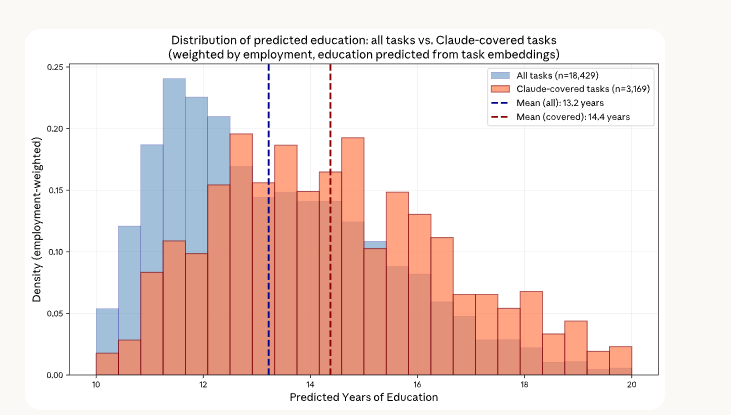
The data aligns with Anthropic’s earlier finding that AI usage is concentrated among white-collar workers rather than manual or service roles.
As an experiment, the researchers modeled what would happen if the tasks currently supported by Claude were fully removed from jobs, known as deskilling. The immediate, first-order effect would be a deskilling of many roles, since the higher-education tasks would disappear first.
For teachers, Anthropic says AI would be able take over tasks such as grading, advising students, writing grants and conducting research, while leaving teachers with hands-on work like classroom management and lectures. Meanwhile, technical writers will be left with editing and reviewing work, while AI covers the core tasks of writing revisions. And AI could strip real estate agents of itinerary planning and selling, and be left with payment collection and ticket printing.
“These patterns illustrate how jobs may evolve over the coming years as their task content adjusts in response to AI. If the education level can be interpreted like expertise in Autor and Thompson’s analysis, their framework might predict that wages will fall and employment will increase for technical writers and travel agents.”
Disclaimer: Opinions expressed at CapitalAI Daily are not investment advice. Investors should do their own due diligence before making any decisions involving securities, cryptocurrencies, or digital assets. Your transfers and trades are at your own risk, and any losses you may incur are your responsibility. CapitalAI Daily does not recommend the buying or selling of any assets, nor is CapitalAI Daily an investment advisor. See our Editorial Standards and Terms of Use.