


Citi Research global head of technology and communications Heath Terry says the recent weakness in some AI chip names is creating an opportunity for long-term investors and dip buyers.
The News
In a new CNBC interview, Terry says bottlenecks cut both ways, as they create demand while also impeding infrastructure construction.
“There’s a reason we call them bottlenecks. And you’re seeing a lot of that right now…. On the demand side of things, just in terms of the ability to build enough infrastructure and have that infrastructure ready at the same time as the chips, lining all of that up is incredibly difficult, and when you see these kinds of blips, that’s usually the reason why.”
His comments come as the custom AI chip leader Broadcom (AVGO) suffered an over 12% decline in just one day, even after beating revenue and earnings per share (EPS) expectations. The company reported $22.19 billion in revenue, above the expected $22.13 billion, and $2.44 EPS versus forecasts of $2.39.
The headline figures disappointed investors who were looking for a much stronger performance. The chipmaker also guided AI chip sales of $16 billion in Q3, below analyst expectations of $17.2 billion, further dampening investor sentiment.
But Citi’s Terry says investors should see pullbacks in strong names as opportunities to “absolutely” buy on dips.
“I mean, these are the opportunities that get created in this. We know what the destination of this looks like. And so when you get these kinds of opportunities, particularly with the companies that you know are leaders, the way a Broadcom is, the way an Nvidia is, the way even within the hyperscalers and Amazon or Microsoft is, you have to take advantage of that.”
What It Means for Investors
Terry appears to be reminding investors that markets don’t move in a straight line and that there will be opportunities to buy on dips when leaders take a breather.
Data shows that Broadcom has an extreme price-to-earnings (P/E) ratio of 77.64, 57% higher than its nine-year average of 49.24. In comparison, Nvidia’s P/E ratio stands at 32.72, well below its 10-year average of 53.72.
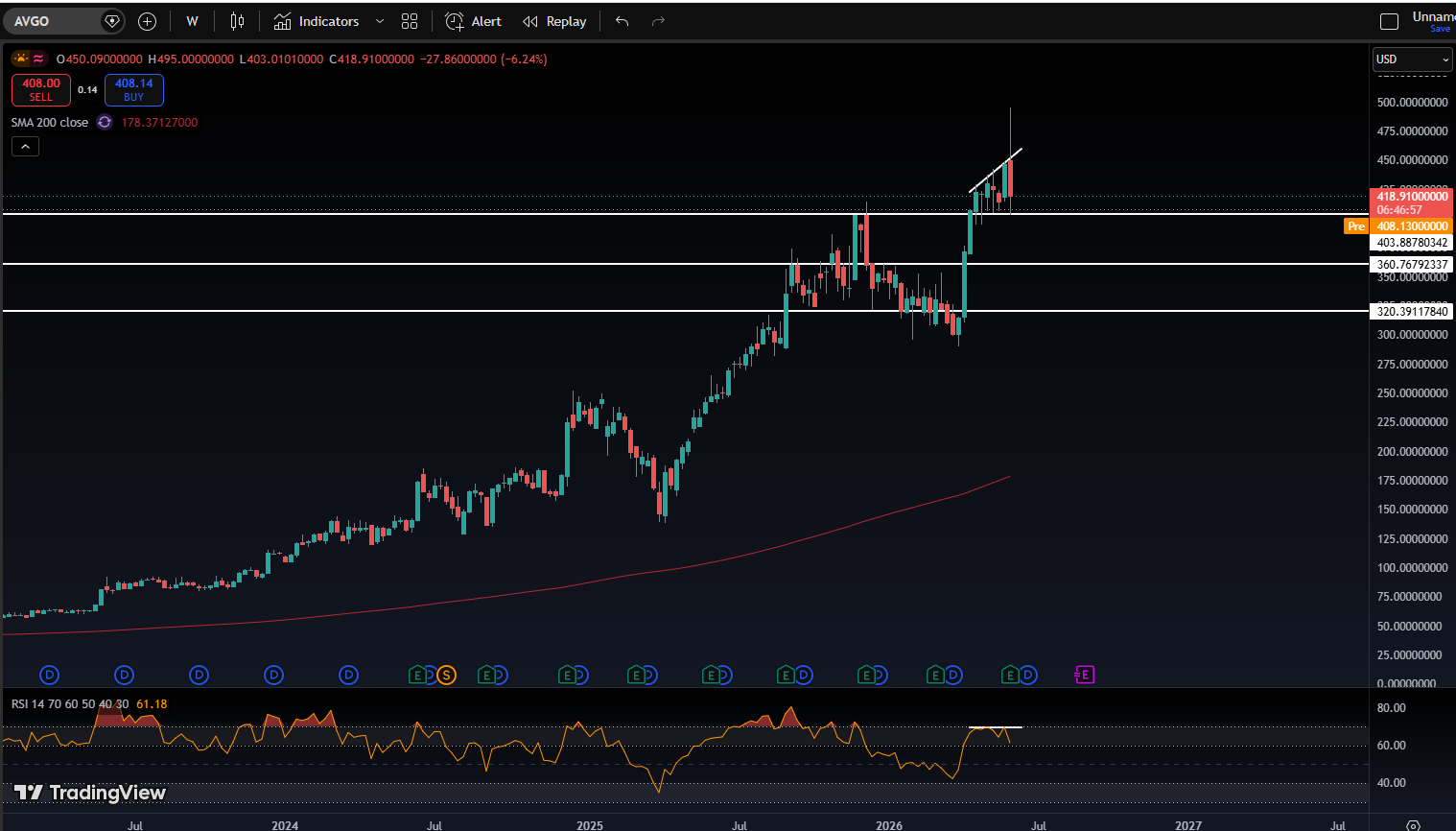
At such an extreme valuation, a slight earnings beat just won’t cut it, as investors want to be impressed to justify its stock price of $418.
Looking at AVGO’s chart, the stock appears to be respecting its weekly support at around $400. But if selling momentum accelerates, the next levels to watch are $360 and $320. The relative strength index (RSI) is also flashing a bearish divergence for AVGO, suggesting that buying momentum is waning despite rising prices.
Fundstrat head of strategy Mark Newton was right on the money after calling the move in semiconductor names unsustainable. But Terry can also be correct that pullbacks open a window for investors to hop on market leaders. If he is, then those who were left sitting on the sidelines can potentially deploy capital at discounted levels.
Disclaimer: Opinions expressed at CapitalAI Daily are not investment advice. Investors should do their own due diligence before making any decisions involving securities, cryptocurrencies, or digital assets. Your transfers and trades are at your own risk, and any losses you may incur are your responsibility. CapitalAI Daily does not recommend the buying or selling of any assets, nor is CapitalAI Daily an investment advisor. See our Editorial Standards and Terms of Use.