


Goldman Sachs chief executive David Solomon says he’s starting to see signs of froth in the markets after seeing how investors reacted to Google parent Alphabet’s follow-on equity deal.
The News
In an interview at the Economics Club of New York, Solomon says he’s looking at Alphabet’s $80 billion capital raise as a case study for the current state of market sentiment.
According to Solomon, the stock is trading up quite well during the “largest follow-on equity deal that’s ever been done,” leading him to believe that investor risk appetite is on the up and up.
“This is the first actual concrete data point for bringing something of this scale, and it’s encouraging. And so, I think there’s plenty of liquidity in the system if the world continues to remain as optimistic, and I do think we’re in a period. And I know when I say this, I’m pausing for a second to say it, but I know when I say it, it will get quoted. But I think it’s definitely true. It’s something for us to reflect on.
We are definitely in a moment where there’s more greed than there is fear.”
Solomon also says the market can absorb deals at the scale of Alphabet’s offering because investors have made a lot of gains in the stock market.
“There’s also unprecedented liquidity and wealth in the markets to absorb some of this. These things also create a virtual flywheel because you’ve got a lot of people that have made a lot of money at a bunch of these companies, and they’re going to be monetizing and reinvesting that into the system, into other things, and paying taxes, by the way, on those gains. And so, there is a virtuous ecosystem, in the context of this, too, that should support it. But it is unprecedented.”
What It Means for Investors
Solomon is the second big bank CEO to warn that greed is now driving market sentiment, following JPMorgan Chase CEO Jamie Dimon’s statement last week that investors are exuberant.
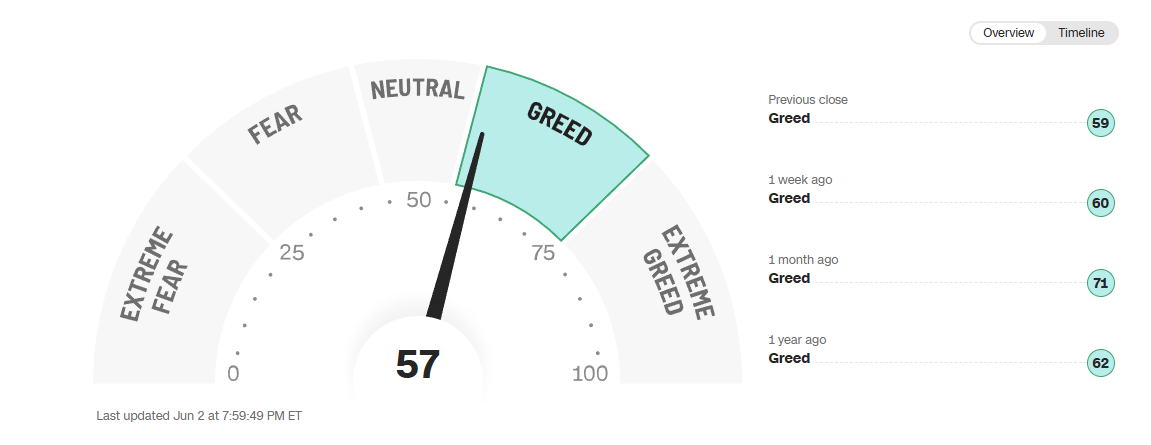
Data from CNN’s Fear & Greed Index shows that while sentiment has swung toward greed, it has not yet reached extreme levels.
Looking at the correlation between greed and stock price movement, the data also suggests that the market can keep rallying despite investor exuberance.
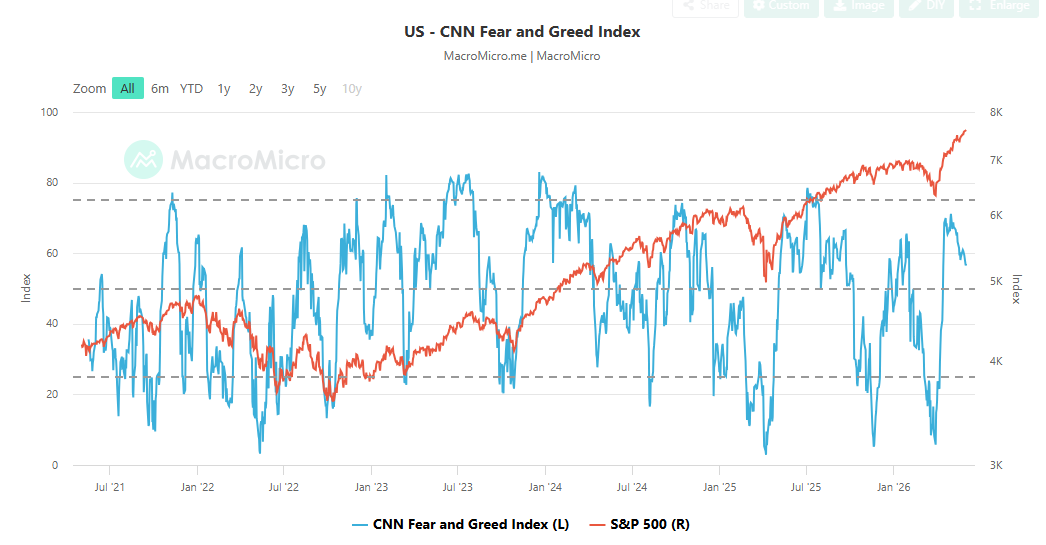
While market sentiment can be a signal for when to buy and sell stocks, particularly at extreme levels, it is not an ironclad strategy. Morgan Stanley CIO Mike Wilson predicted that the S&P 500 will surge to 8,300 in the next 12 months, driven entirely by higher earnings estimates. Dimon also said that the market can stay exuberant for a long time, and “it’s not bad.”
Taken together, Solomon and Dimon may be warning that the market is flashing a yellow signal, but it does not necessarily mean that the bull market will be over anytime soon. Data consistently shows that buy-and-hold investors have significantly outperformed those who act on emotional impulses.
History tends to reward the investor who stays put over the one who reacts to noise.
Disclaimer: Opinions expressed at CapitalAI Daily are not investment advice. Investors should do their own due diligence before making any decisions involving securities, cryptocurrencies, or digital assets. Your transfers and trades are at your own risk, and any losses you may incur are your responsibility. CapitalAI Daily does not recommend the buying or selling of any assets, nor is CapitalAI Daily an investment advisor. See our Editorial Standards and Terms of Use.