

The performance gap between American and Chinese artificial intelligence models has nearly vanished, according to Stanford University’s latest research.
In its 2026 AI Index Report, Stanford finds that the two countries have been running neck and neck at the top of global AI benchmarks, with the lead changing hands multiple times over the past year.
“US and Chinese models have traded the lead multiple times since early 2025. In February 2025, DeepSeek-R1 briefly matched the top US model, and as of March 2026, Anthropic’s top model leads by just 2.7%.”
Stanford notes, however, that the scorecard looks different depending on the metric.
“The U.S. still produces more top-tier AI models and higher-impact patents, while China leads in publication volume, citations, patent output, and industrial robot installations.”
The report also highlights an unexpected leader in the global AI race.
“South Korea stands out for its innovation density, leading the world in AI patents per capita.”
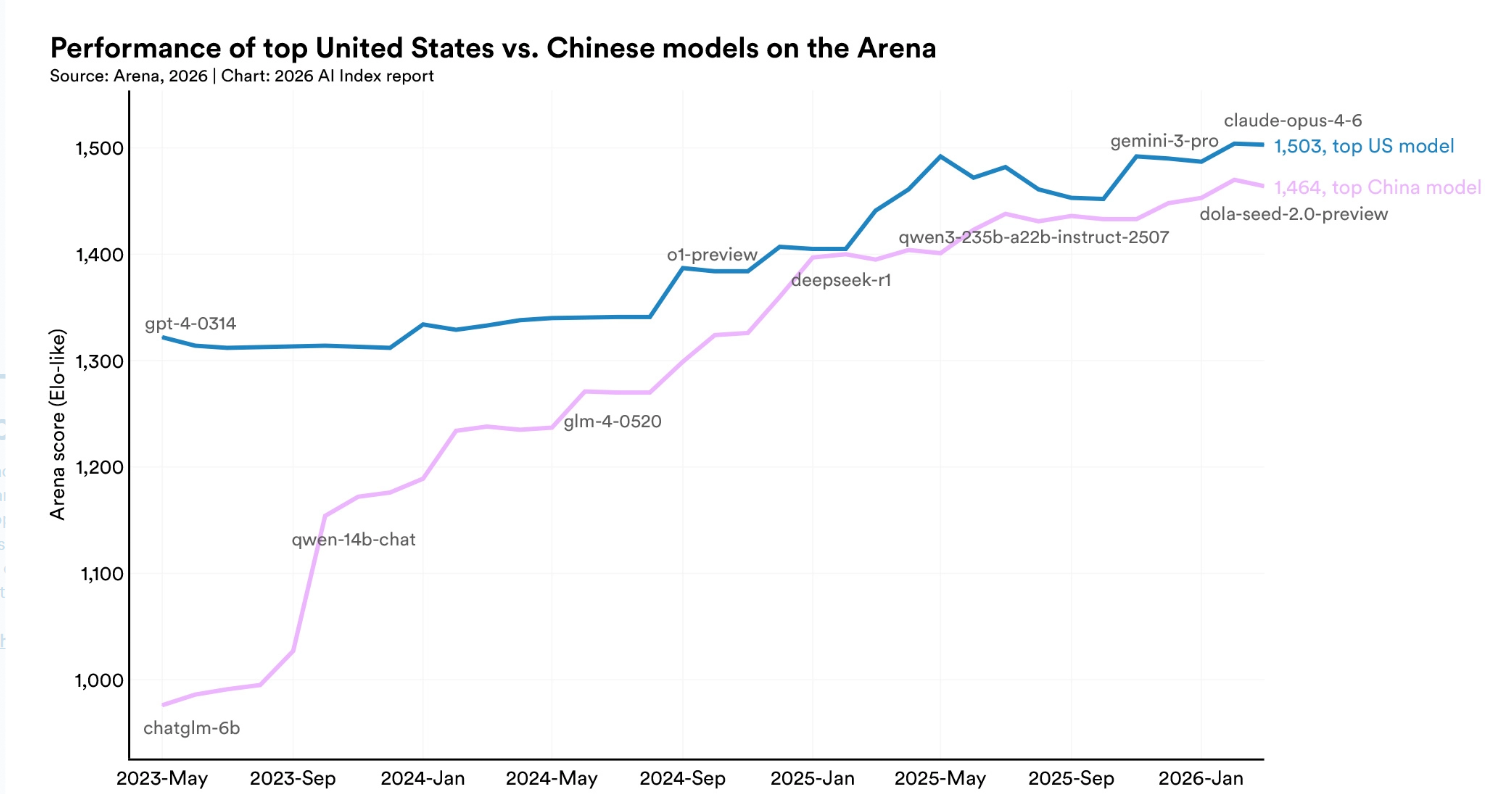
Looking at Stanford’s data, it appears that Anthropic’s Claude Opus 4.6 is leading, but ByteDance’s multimodal AI foundation model Dola-Seed-2.0-Preview is not far behind.
The study also finds that the US may be investing hundreds of billions of dollars in AI CapEx, but it is witnessing a massive decline in attracting global talent.
“US private AI investment reached $285.9 billion in 2025, more than 23 times the $12.4 billion invested in China—though looking at just private investment figures likely understates China’s total AI spending, given its government guidance funds. The US also led in entrepreneurial activity with 1,953 newly funded AI companies in 2025, more than 10 times the next closest country.
However, the number of AI researchers and developers moving to the US has dropped 89% since 2017, with an 80% decline in the last year alone.”
Stanford also finds that AI adoption is rising at a blistering pace, but the US is not even in the top 20 globally.
“Generative AI reached 53% population adoption within three years, faster than the PC or the internet, though the pace varies by country and correlates strongly with GDP per capita. Some show higher-than-expected adoption, such as Singapore (61%) and the United Arab Emirates (54%), while the US ranks 24th at 28.3%.”
You can read the full report here.
Disclaimer: Opinions expressed at CapitalAI Daily are not investment advice. Investors should do their own due diligence before making any decisions involving securities, cryptocurrencies, or digital assets. Your transfers and trades are at your own risk, and any losses you may incur are your responsibility. CapitalAI Daily does not recommend the buying or selling of any assets, nor is CapitalAI Daily an investment advisor. See our Editorial Standards and Terms of Use.